

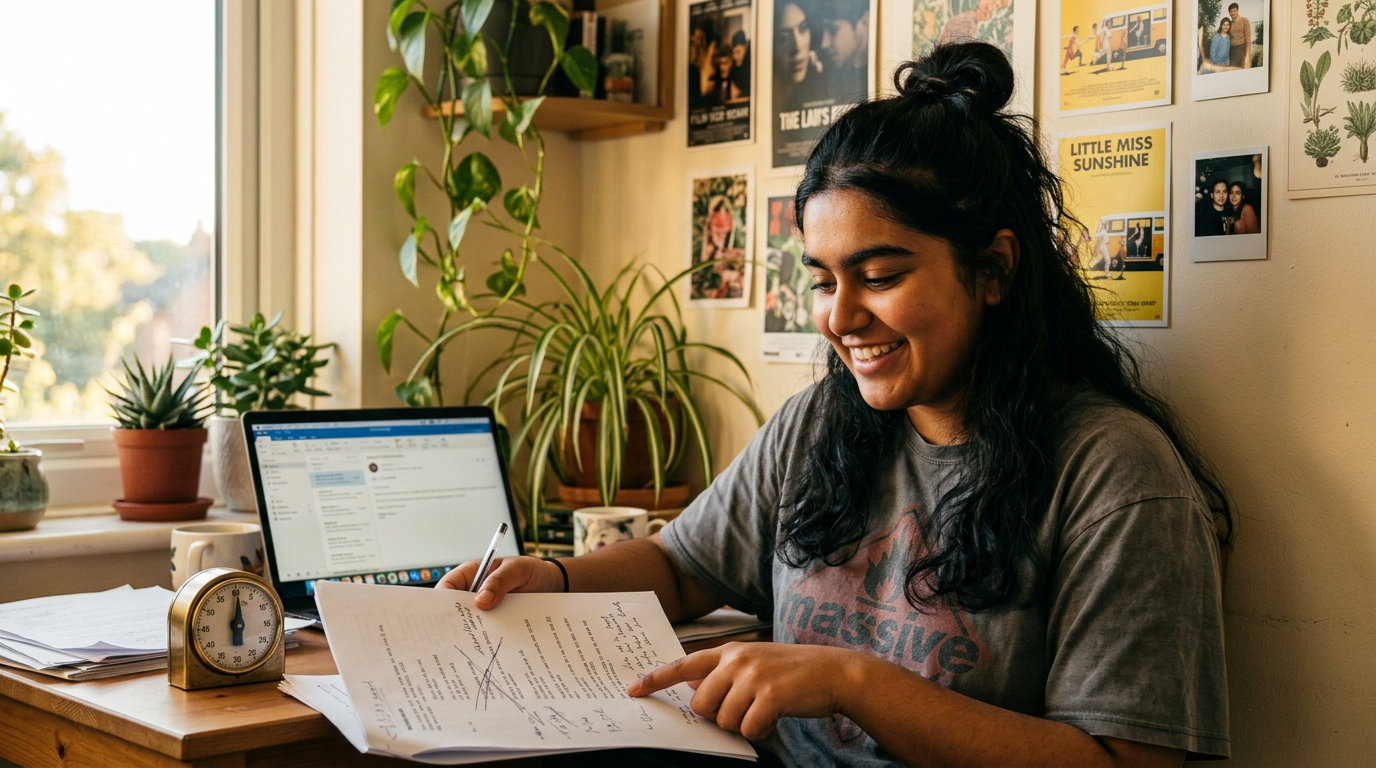
About 750 words. That's at 150 words per minute (wpm), a typical pace for talking to camera. A slower, explainer-style read at 130 wpm brings it down to 650 words, and a brisk read at 170 wpm takes it up to 850. The table below covers 30 seconds to 20 minutes at all three paces.
Words in a script, by running time
A script's length in words is its running time in minutes multiplied by your speaking pace in words per minute.
So the only number you really need is your pace. Here's what the common ones give you.
| Running time | 130 wpm (explainer) | 150 wpm (conversational) | 170 wpm (brisk) |
|---|---|---|---|
| 30 seconds | 65 | 75 | 85 |
| 1 minute | 130 | 150 | 170 |
| 2 minutes | 260 | 300 | 340 |
| 3 minutes | 390 | 450 | 510 |
| 5 minutes | 650 | 750 | 850 |
| 10 minutes | 1,300 | 1,500 | 1,700 |
| 15 minutes | 1,950 | 2,250 | 2,550 |
| 20 minutes | 2,600 | 3,000 | 3,400 |
To go the other way, divide. A 1,000-word script at 150 wpm runs 6 minutes 40 seconds.
Which column are you?
The three paces are rules of thumb by format.
- 130 wpm: tutorials and explainers. You're defining terms, showing something on screen, and leaving the viewer time to follow. Slower is a feature here.
- 150 wpm: vlogs, updates and talking heads. Roughly the pace of a relaxed conversation across a desk.
- 170 wpm: ads and promos. Tight scripts where every second costs something. Hard to hold for more than a minute or two without sounding rushed.
But these describe formats, not you. Two people reading the same script can easily be 20 or 30 wpm apart, and that gap is a minute or more on a ten-minute video. Your own number beats any table.
Your script is shorter than your video
Words fill speaking time, not running time. Plenty of a video's minutes have nobody talking in them.
- Pauses. A one-second beat after each of 20 key points is 20 seconds. That's 50 words' worth at 150 wpm.
- Demos and B-roll. If you cut to 30 seconds of screen recording with no voiceover, that's 75 words you don't need.
- Title cards and outros. A 20-second intro sequence is time the script doesn't have to fill.
So work backwards from what you'll actually say. For a five-minute video with a 20-second intro and a 30-second silent demo, you're speaking for 4 minutes 10 seconds. At 150 wpm, that's about 625 words, not 750.
Find your own pace in five minutes
- Take 300 words of your own script. Your own writing, not a book. Your pace on your sentences is the number that matters.
- Read it out loud, the way you would on camera. Sit where you film, at the volume you'd use. Reading in your head runs far faster than speech and tells you nothing.
- Time it, and divide. 300 words in 2 minutes 5 seconds is 300 ÷ 2.08, or about 144 wpm.
Do it twice and keep the second number. The first read is always a little stiff.
If your number feels slow or fast on playback, pace is one of the five causes in how to read a teleprompter without sounding like you're reading.
How cuekards handles this
It counts the words for you. Paste a script or load a Google Doc, and the line under the script box shows the word count and an estimated running time, for example "750 words · ~5:46 at 130 wpm".
The estimate uses your speed setting. It's worked out from the fixed-scroll speed in Settings, which starts at 130 wpm. That's at the slow end for most people talking to camera, so out of the box the estimate runs long. Set it to the pace you measured and the estimate becomes yours.
Notes don't count. Anything in [square brackets] and any line starting with # is shown on screen but never read aloud, so it's left out of the word count. Write as many stage directions as you like.
With Follow my voice on, the number is for planning only. The script moves at whatever pace you read, so you never pick a speed for the take itself. Speed up, slow down, stop for a demo. The prompter waits. How voice-following works covers the mechanism.
With it off, the same setting drives the scroll. The script moves at a constant speed, anywhere from 40 to 400 wpm, and only while you're recording. Follow my voice is English only for now, so this is the mode for a script in any other language.
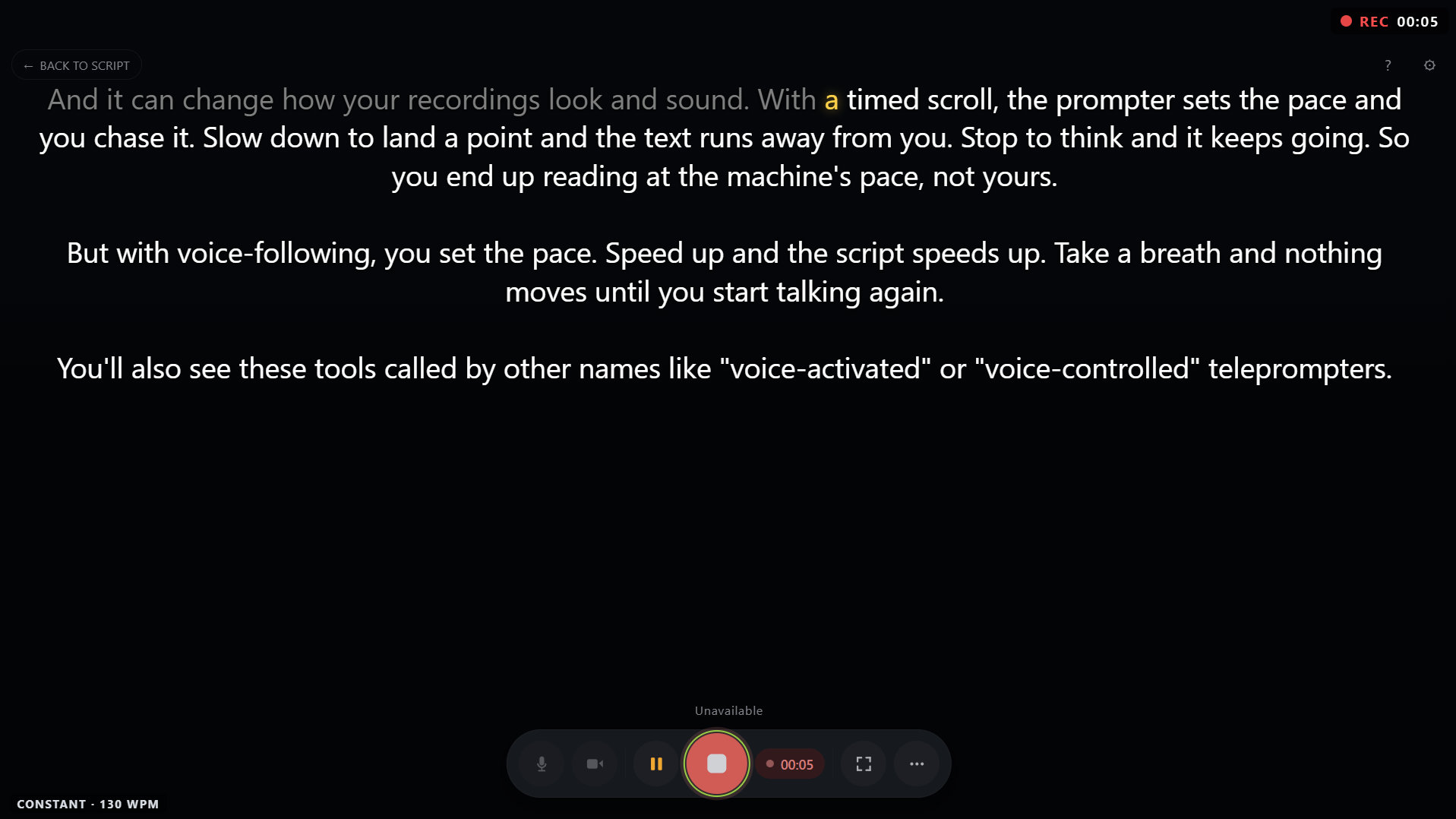
The full setup, from pasting a script to saving the take, is on how it works.

How long is a 1,000-word script?
About 6 minutes 40 seconds at 150 wpm. At 170 wpm it's just under 6 minutes, and at 130 wpm it's just over 7 and a half.
How many words is a 60-second ad?
Between 130 and 170, so about 150. A 30-second ad is about 75. Leave room for an end card or a logo, though: a 60-second spot that speaks for 50 seconds needs closer to 125 words at 150 wpm.
How many words is a 10-minute speech?
About 1,500 at 150 wpm. Speaking to a room usually runs slower than speaking to a camera, with pauses for the audience to react, so 1,300 is a safer target.
Does reading from a teleprompter make you speak slower?
It can push you either way. A timed scroll set slower than your natural pace drags you down to it, and one set faster hurries you. A voice-following prompter doesn't change your pace at all, because it moves at whatever speed you read.
Open cuekards, paste your script and read the count under it. Then read the first 300 words aloud against a timer, put your number into Settings, and the estimate is yours.